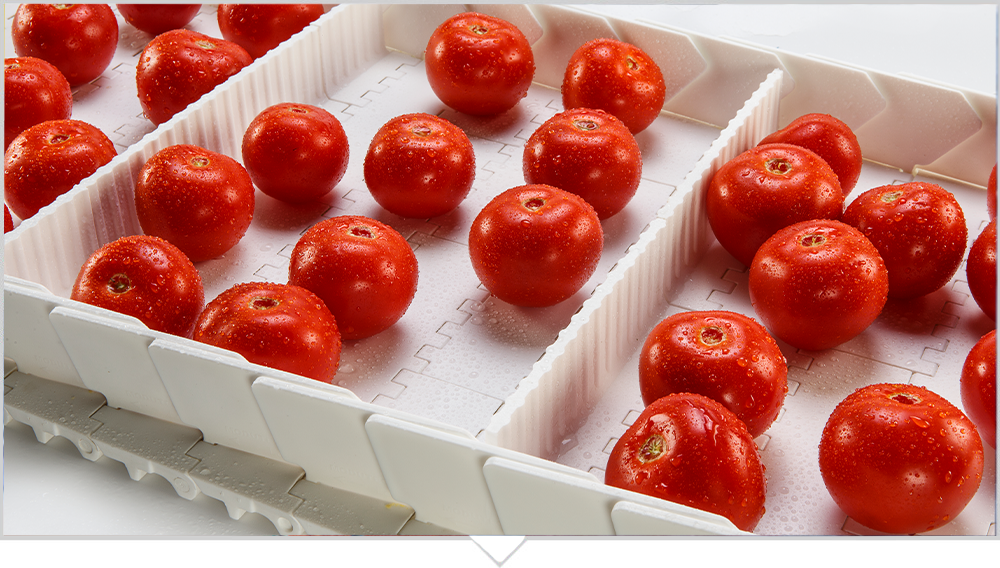
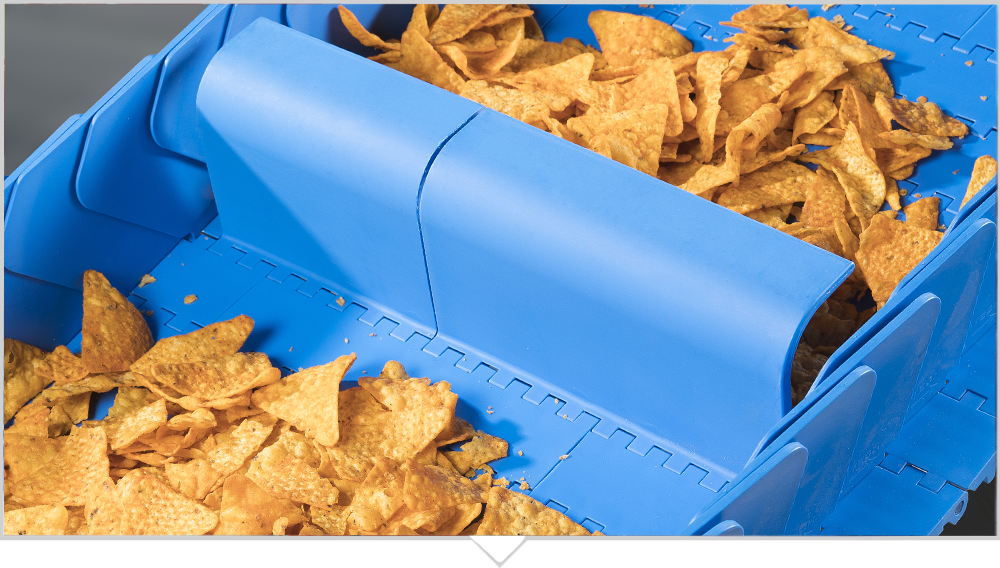
Your reliable solution for hygienic conveying processes. Our modular conveyor belts made of high-quality plastic offer maximum adaptability for a wide variety of applications in the food, packaging, and logistics industries. Die robuste, modulare Bauweise sorgt für zuverlässigen Betrieb und schnelle Wartung – ideal für anspruchsvolle Produktionsumgebungen.
Key Advantages
Modular system: Rapid replacement of individual modules; minimal downtime.
High efficiency: Reliable transport even for demanding or challenging goods.
Hygienic and easy to clean: Simple cleaning process.
Flexible application: A wide variety of surfaces and accessories, such as cleats and side guards.
Manufacturer-independent: Compatible solutions available for virtually all systems.
Linear conveyor belts
Inclined conveyor belts
Overview of the Different Belt Types
Something for every requirement:
1
Food Industry
Modular belts are used in the food industry for conveying and processing products across many sectors, for example, in baked goods, confectionery, dairy products, meat, poultry, seafood, and agricultural products. They are utilized in both manufacturing and processing.
Common materials and designs: Modular belts primarily utilize plastic links; in practice, POM-based rigid elements are widely used because they offer stiffness, impact resistance, and excellent sliding properties. Depending on the application, versions with different pitches, surface structures, and designs for curved or spiral conveyors are available.
Typical areas of application:
Baked goods and dough processing, such as for bread, rolls, and pastries.
Meat, fish, and poultry, where moisture, fat, and frequent cleaning play a major role.
Dairy and cheese production, especially for sticky or sensitive products.
Curved, spiral, and wet applications, when flexible line routing or special environmental conditions are required.
2
Corrugated board industry
Modular plastic belts are used in corrugated board plants primarily for transporting paper rolls, corrugated sheets, stacks, bundles, and cardboard packaging. Typical stations include stack transport and the distribution of sheets within the production flow.
Typical advantages: The major advantage is the combination of robustness, stiffness, and simple repair. For the corrugated board industry, clean, non-marking transport, high process reliability, and reduced product damage are also essential.
Key requirements: In this industry, belts must deliver high mileage, wear resistance, and stable tracking at high speeds. Depending on the section, good adhesion, precise alignment, and smooth transfers are also required, especially for stacks and sheet goo
Typical belt solutions:
Straight-running modular plastic belts for mass conveyance and stack transport.
Textured surfaces for improved slip resistance.
Smooth belts for horizontal paths and gentle transport.
3
Logistics Industry
Modular belts are used in logistics and distribution centers for conveying, sorting, parcel flow, warehouse logistics, and baggage handling. They are particularly suitable for light to medium-duty applications and can be seamlessly integrated into conveying, sorting, and transfer systems.
Typical advantages: Key advantages include high robustness, easy maintenance, and the ability to quickly expand or reconfigure systems. Furthermore, modular systems help maintain a stable material flow and reduce damage to package
Key requirements: In logistics, the main priorities are reliability at high cycle rates, excellent tracking stability, and precise product guidance. Depending on the facility, curve conveyors, transfer points, elevation changes, and sorting lines are also utilized.
Typical belt solutions:
Modular plastic belts made of PP or POM for robust standard applications.
Side-flexing (radius) belts for directional changes and space-saving layouts.
The possibilities for modular belts are endless. Contact us and we will find the best solution for you.